

Free guide for fundraisers
How do you ethically ask someone to share their story with your nonprofit?
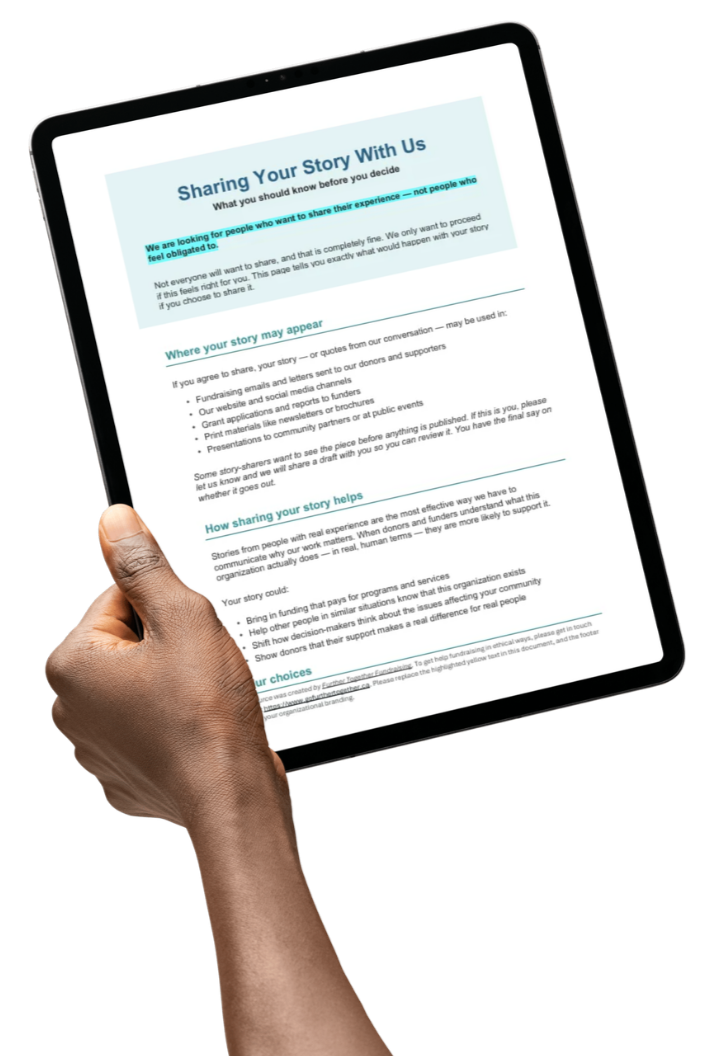
Start with consent that's informed, ongoing, and reversible. Let the person decide what gets told. That's the short version. The full process is in our free one-page guide. Get yours here:
Why we built this
In a Stanford study, 5% of students were able to name a statistic while 63% remembered the story. Stories deepen bonds and are memorable
Every nonprofit needs stories. Donors want to understand the difference their gift makes, and a good story shows that in a way a stat never will.
But a story is also someone's real life. The person telling it is trusting you with something personal, often at a moment when they're relying on your organization for support.
That trust comes with responsibility.
Most fundraisers were never taught how to navigate this the way; no one ever showed them what a respectful process looks like. This guide is that process, on one page.
What makes storytelling ethical
It starts with a simple shift: the person sharing their story is a partner in your mission, not a prop in your story. A few things follow from that.
They decide what gets shared
Not you, not your board, not your Executive Director.
Dignity at the heart of it all
A story doesn't need someone at their lowest point to be powerful. Sensational details cost the storyteller something real.
Consent is ongoing
Someone who agreed last year doesn't owe you that story forever. "Not this part" and "not anymore" are both honored, without consequence.
Transparency goes both ways
The storyteller deserves the same clarity you'd want: where it appears, who sees it, how long it's used.

Why this is harder than it sounds

Most fundraisers already agree with the principles above. Living up to them is the hard part.
There's a real power gap between an organization and the people it serves, especially when someone relies on your programs for support. Even with the best intentions, a service user can feel pressure to say yes, or to tell the story in the way they think you want to hear it. A "no" can feel risky to them, even when it isn't.
Every handoff — from program officer to comms officer to social media — is a place where the storyteller's actual intent can get lost.
In a smaller shop, one person handles the whole conversation, start to finish. In a larger one, a story usually passes through more hands, and no single person along that chain feels responsible for the whole thing. Most organizations don't have anything written down for this — the quality of consent depends on whoever happens to be holding the conversation. This resource changes that.
What ethical storytelling does for your fundraising
Doing right by the storyteller is what builds a stronger fundraising program.
Better stories
People open up more, and share more specific, human detail, when they know exactly how their words will be used and that they're in control.
Lasting relationships
Community-Centric Fundraising treats the people you serve as long-term partners, not one-time “content”.
Protection
A storyteller who feels respected isn't usually asking you to take their story down six months later.
Survives handoffs
A shared process means a story's consent terms travel with it, from collection to write-up to approval.
What's in the guide
⚡Plain-language talking points to explain how a story will be used, before you ask for it
⚡A simple way to walk someone through informed, ongoing, and retractable consent — without making it feel like a legal form
⚡Questions that invite someone to share on their own terms, instead of steering them toward the version you want
⚡A short checklist to run through before any story goes live

Help your community share their story with dignity and consent
Download our free one-pager to guide ethical
story-sharing conversations with the people you serve.